
Two of the most important tree species used in musical instrument-making are under increasing pressure: African Blackwood (Dalbergia melanoxylon), used to make high-quality woodwind instruments including clarinets and oboes, and Pernambuco (Paubrasilia echinata), prized for the bows used by string players and a material that has been part of bow-making for more than 250 years.
Protecting their use in the manufacturing process is something the industry has a very real stake in.
The industry has a seat at the table
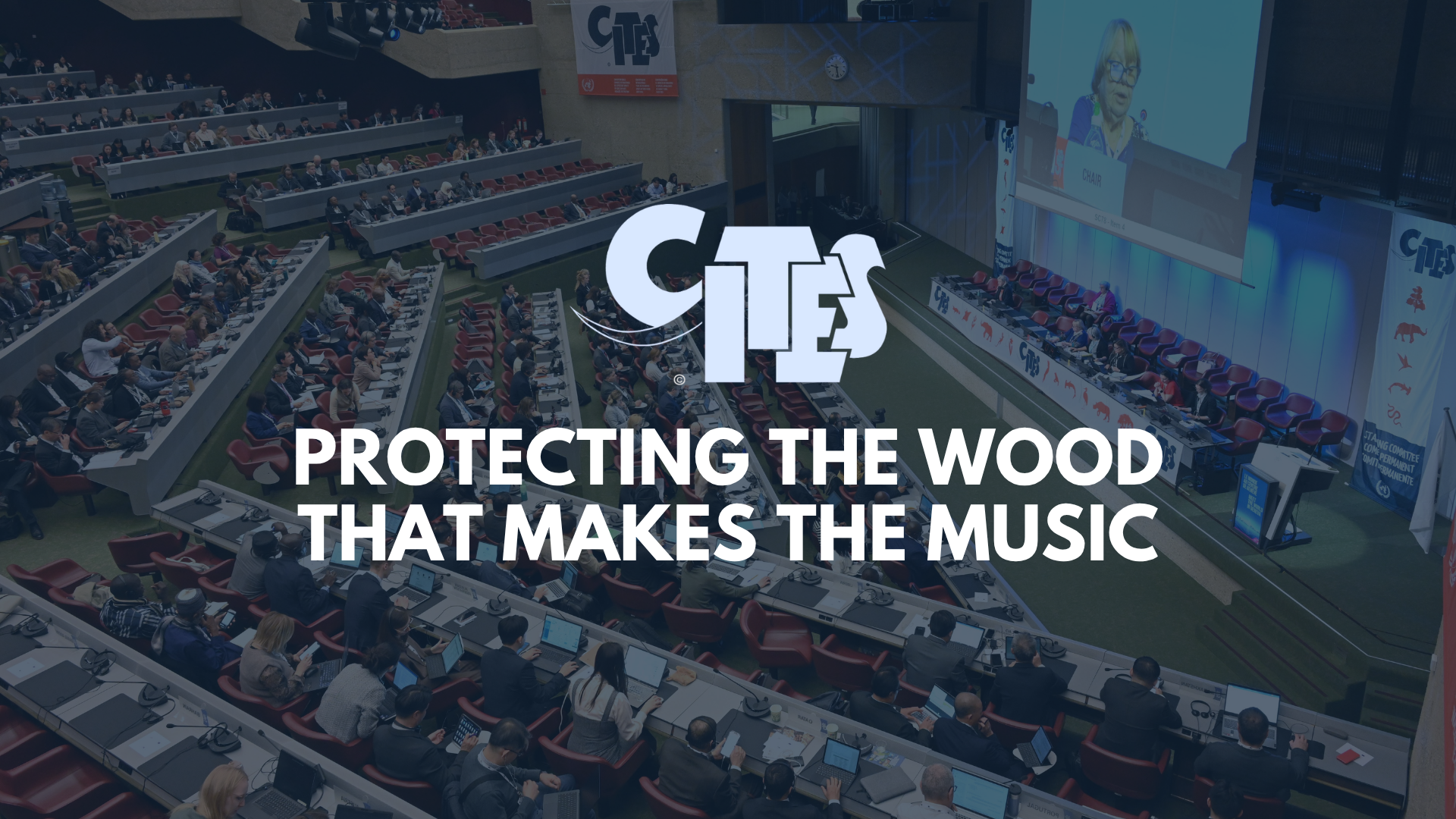
Back in July the MIA announced that it had joined the European Soundmakers a confederation of European Trade Associations created to give the European music instrument sector a stronger collective voice on matters like this one. As such it was a significant to see the European Soundmakers (ESM) representing the musical instrument industry directly at the CITES Plants Committee 28 (PC28) in Geneva.
For the first time, ESM took part in the committee, with its representative Michael Jousserand attending alongside Jacques Carbonneaux of Chambre Syndicale de la Facture Instrumentale. CSFI are a founding member of ESM and Jacques brings a wealth of experience having represented the industry at every CITES committee since 2017.
On behalf of the european musical instrument industry, they were able to speak directly to governments and conservation organisations about the challenges facing these vital species.
And, importantly, this wasn’t about choosing between conservation and industry. It was about recognising that we need both.
Sustainable use can support conservation
For African Blackwood, ESM called for better forest inventories, stronger traceability and voluntary partnerships between the countries where the species grows and the musical instrument industry.
The aim is simple: make sure the species is protected for the long term while allowing sustainable, legal use to continue.
That principle is particularly important for an industry that depends on natural materials. Musical instrument makers have a long-term interest in healthy forests and sustainable supply chains. If the resource disappears, so does the ability to make the instruments that musicians rely on.
Pernambuco provides an encouraging example of what can happen when conservation and industry work together.
Found only in Brazil, Pernambuco has been used for stringed instrument bows for centuries. ESM expressed its support for Brazil’s conservation proposal and highlighted the work of the International Pernambuco Conservation Initiative (IPCI), which has spent more than 25 years demonstrating what industry-led conservation can achieve.
Why this matters to all of us
For those working in the musical instrument industry, sustainability can sometimes feel like a much bigger issue than simply the materials we use.
But this is a very tangible example of why it matters.
The wood in an instrument isn’t just a raw material. It’s part of the future of the instrument itself – and of the industry that makes, distributes, sells and maintains it.
That’s why stronger collaboration between governments, conservation organisations and the musical instrument industry is so important.
ESM also voiced its support for the CITES Tree Species Programme (CTSP) and called for it to become a permanent programme – helping to build the long-term knowledge, cooperation and conservation measures needed to protect tree species at risk.
There is a clear message here: sustainable, legal use and conservation aren’t opposing goals. They have to work together.
The musical instrument industry needs healthy forests. Healthy forests need responsible management. And finding solutions that work for both is something our industry should be part of.
A stronger voice for our industry
The MIA is proud to be a member of European Soundmakers and to see our industry represented directly on this international stage.
Leveraging knowledge and support from across Europe will be vital for this kind of advocacy to be effective, and so we would ask all members touched by this topic to contact us if they want to feed into the debate or can help provide evidence and case study that support the industry ask.